One of the trickiest and most bewildering aspects of the college search process is creating a well-crafted list of potential schools for a teenager. This critical aspect of the college experience isn’t something that I have focused on for a while, which is why I am remedying that today.
I am sharing information contained in three new books on college which are valuable resources for any family who needs direction on winnowing down a list of worthy and affordable candidates.
Three book lineup
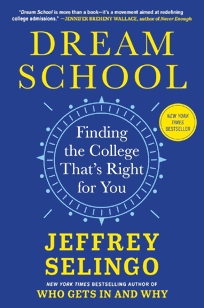
Dream School: Finding the College That’s Right for You by Jeffrey Selingo, a New York Times bestselling author and a former editor of The Chronicle of Higher Education.
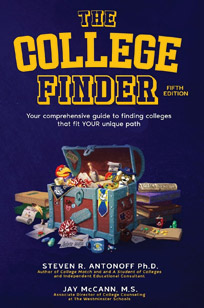
The College Finder (Fifth edition) By Steven R. Antonoff, a nationally known independent college consultant and Jay McCann, a private high school counselor.
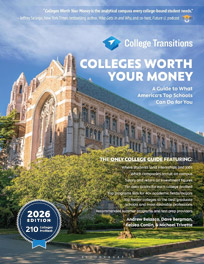
Colleges Worth Your Money: A Guide to What America’s Top Schools Can Do for You (Sixth edition) by Michael Trivette and Andrew Belasco, who are co-founders of College Transitions, a national college consultant firm.
Insights from the three books
Dream School
The type of parents and teenagers who fixate on what colleges are looking for in applicants tend to be the ones who are most anxious—and even frightened—about the college process.
When this is the focus, which often involves striving to be an ideal candidate for highly selective colleges, families are more likely to fail at finding ideal institutions that will set students up for success in college and the years that follow.
Selingo argues persuasively that a “Top 25 or bust” mentality is way too narrow and too risky considering low acceptance rates, rising costs and greater volatility in admissions.
He urges families to prioritize what a school delivers such as post-graduation earnings, internships, mentoring, and meaningful learning experiences. The latter, I would suggest, means avoiding schools where undergrads are stuck in lecture halls for most of their college years.
In his quest to prod families to throw a wider net, Selingo highlights what he calls 75 “new dream schools” that provide strong value, student engagement and desirable outcomes.
He divided the featured schools into these three categories:
Hidden values: Many small private colleges with strong graduation outcomes and opportunities for fulfilling careers:
Examples:
- Augustana College (IL)
- Berry College (GA)
- Butler University (IN)
- Elon University (NC)
- Stevens Institute of Technology (NJ)
- University of the Pacific (CA)
- University of Dayton (OH)
Breakout Regionals: Mostly public universities that tend to draw most students from close by that offer a compelling value compared to expensive alternatives.
Examples:
- Baruch College (NY)
- California State Polytechnic University, Pomona (CA)
- The College of New Jersey (NJ)
- Florida A&M University (FL)
- George Mason University (VA)
- University of North Carolina, Asheville (NC)
- Washington State University (WA)
Large leaders: Big research universities that offer attractive opportunities that many students overlook.
Examples:
- Clemson University (SC)
- Miami University of Ohio (OH)
- Rutgers University (NJ)
- Texas A&M University (TX)
- University of Missouri, Columbia (MO)
- University of Pittsburgh (PA)
- University of Utah (UT)
A model way to search for colleges
In Dream School, you’ll also find examples of real families navigating choices and their successful results.
Katelynn, a junior from New Jersey, initially wanted to go to Clemson University in South Carolina because many of her friends wished to attend. When her dad Jake checked Clemson’s net price calculator, however, the school would have cost $60,000 a year. That was a financial nonstarter for the parents.
Katelynn, a potential mathematics major, gave up on Clemson, but then fixated on attending selective private East Coast colleges like Holy Cross and Franklin & Marshall.
Initially, the net price calculator showed that Holy Cross was on the edge of what the family could afford at roughly $41,000. But when the dad used the net price calculator during his daughter’s senior year, the Catholic institution’s net price had jumped to more than $50,000. The price ballooned because the value of their home had risen. This was another nonstarter.
Jake decided to search for mid-sized Jesuit colleges in the Northeast and Mid-Atlantic. One of the tools that he used was the federal College Scorecard where he checked the median earnings of graduates at other Jesuit colleges compared with Holy Cross.
In his research, a school that kept popping up was Loyola University in Maryland. When he checked median salaries of Loyola and Holy Cross there wasn’t a huge difference—$83,000 versus $90,000. Jake discovered that Loyola bested Amherst College, an elite liberal arts college, on earnings overall.
(An excellent way to check the return on investment of different majors at more than 40,000 undergraduate institutions is The Foundation for Research on Equal Opportunity (freopp.org). This tool wasn’t mentioned in the book, but I discuss it in The Financial Advisor’s Guide to Savvy College Planning.)
Jake also conducted a deep dive on LinkedIn and looked at the profiles of math major graduates to see where they interned, worked and attended graduate school. He discovered that mathematics graduates at Loyola compared favorably with more prestigious colleges and he concluded they outhustled grads from elite institutions.
Katelynn’s award offer from Loyola dropped the price to roughly $40,000 but then right before the deposit deadline, Loyola offered Katelynn an extra $5,500 for her freshman year. With that extra offer, Loyola became the most affordable school left on her list including two state schools, Rutgers University in her home state and Binghamton University in New York. She decided to attend Loyola.
The College Finder
This isn’t a stereotypical book that provides lots of information about navigating the college process.
The College Finder is comprised almost exclusively of lists of colleges. The 884-page book includes more than 1,200 lists that the authors compiled with the help of hundreds of college consultants and high school counselors, who weighed in with their suggestions.
College Finder, now in its fifth edition, can serve as an excellent resource to generate school ideas beyond just the brand names. Arguably, the most valuable lists suggest institutions that offer well-regarded programs for different disciplines.
You’ll find experts’ recommendations for schools that offer degrees in such disciplines as psychology, business, nursing, political science, environmental science and biology. You’ll also find suggestions for less common majors such as cybersecurity, sports management, entrepreneurship, robotics engineering, game design and photography. There is even a list of recommended schools that offer majors in the cannabis industry.
You’ll find many lists in such categories as student support, enrollment, politics, practical experience, housing, study abroad, Greek life and faculty. Under the faculty category, readers will see lists that include:
- Colleges with top-rated professors
- Accessible professors
- Colleges that prioritize spending on instruction
Colleges Worth Your Money
The sixth edition of this popular book focuses on 200 private and public colleges and universities that are worth considering during a higher-ed search. A chief aim of this data-driven book is to help measure the return on investment of each institution.
The book offers 75 key statistics for each institution along with a narrative commentary. The statistics include:
- Admission metrics, test scores and graduation/retention rates
- Average need-based and merit aid
- Average debt for graduates
- Beginning salary and career outcomes of graduates
- Institutional supports such as career services
There are also sections listing “Top Programs” and “Top Feeders,” as well as recommended summer programs and test-prep providers.
The book includes a discussion on how to interpret and use the data and how to evaluate tradeoffs such as cost versus returns.
Give valuable advice
Any one of these books, or all of them for that matter, would make for extremely helpful resources for client families with their eyes toward sending a child or children to college.